
The color of your child’s swimsuit could impact their safety at a swimming pool or the beach. That’s according to water safety experts who have taken a close look at how the hue of swimwear may influence how visible a child is under water.
“A child’s swimsuit color can significantly impact their visibility in the water, which is crucial in preventing drownings. Bright and contrasting colors stand out more clearly against the water, making it easier for lifeguards and parents to spot a child quickly, especially in an emergency situation,” Bernard Fisher, director of health and safety for the American Lifeguard Association, said in an email.
“People should avoid swimsuits in light blue, gray, or green as they can blend with the water and pool surroundings, making it difficult to spot a child. We recommend bright and contrasting colors such as neon yellow, orange, pink, and bright red,” Fisher added. “These colors are highly visible both underwater and on the surface.
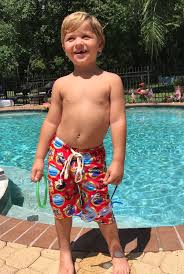
Swimsuit colors are not talked about enough in public safety, said Wyatt Werneth, a coastal lifeguard in Florida and spokesperson for the American Lifeguard Association./Printerval
Swimsuit colors are not talked about enough in public safety, said Wyatt Werneth, a coastal lifeguard in Florida and spokesperson for the American Lifeguard Association.
“The bright clothes are something that we’ve identified as being a game-changer. If you have the same colors of the water or the environment, you’re going to blend in,” Werneth said while patrolling Cocoa Beach.
“We consider this also with missing children. Not only the fact that the bright colors are going to help us locate them in a pool environment or the beach, but one of the things that lifeguards do more than anything else – you think we go out and wrestle with sharks and save people from rip currents – but we also look for missing children at the beach,” he said. “If they’re wearing a bright color, and if you take a picture of those children before, then we’ll have a picture and know what to look for. So, you can help us – not only can drowning be prevented, missing persons’ [cases] can be prevented as well.”
Swimsuit color test
A company called Alive Solutions, which specializes in water safety, has found in two separate experiments that certain swimsuit colors are easier to spot in a swimming pool or open water, such as a lake.
In tests, the company’s water safety experts placed swimsuits of various colors in swimming pools and lakes to determine how visible they may be. The tests were conducted independently and not published in a peer-reviewed journal.
“In our main testing we did 14 different colors,” Natalie Livingston, co-founder and owner of Alive Solutions, said in an email.
“Water is not like looking through air. Even the tiniest bit of surface agitation, glare, or movement in the water can cause objects and people to become distorted,” she said. “Visibility in water can be increased or decreased depending on the color of a swimsuit or clothing.”
Livingston, who has been a lifeguard for more than 25 years, remembers watching her children at the pool one afternoon with other parents and that’s when she realized that some children wearing either dark- or pastel-colored swimsuits seemed to visibly disappear in the water. Her colleagues and she later decided to conduct the tests from 2019 through last year.
In a swimming pool, with a light-colored bottom, the company’s tests showed that neon pink and neon orange appeared to be the most visible. Darker colors showed up against the light pool bottom, but could often be dismissed for shadows, leaves or dirt. White and light blue swimsuits were not as visible and seemed to disappear completely in the pool.
“Light colors or blues tend to look like glare spots or cloud reflections, or completely blend in with the environment,” Livingston said in the email.
In 18 inches of lake water, the tests showed that bright neon colors – including neon orange, yellow and green – were most visible against the lake bottom, but neon pink did not perform well. White swimsuits appeared more due to reflecting light, but not as much as the bright neon colors. All other colors were not very visible.
Overall, Livingston said, neons won for visibility in all environments.
“We have heard from so many parents that said they had their kid in a bright-colored swimsuit and the color caught their attention out of the corner of their eye and they responded to prevent a drowning event,” Livingston said. “Of course, the color of the suit doesn’t matter if no one is supervising effectively, but it can and does help in partnership with effective supervision and other layers of water safety prevention.”
Layers of water safety
It certainly makes sense that bright swimsuit colors can play a role in making a child more visible in the water in case of an emergency, but there isn’t “real-world evidence” that having a child in a neon bathing suit leads to better outcomes in a drowning event, said Dr. Maneesha Agarwal, an associate professor of pediatrics and emergency medicine at Emory University School of Medicine.
“The goal is that you never have to even rely on your child’s bathing suit color to find them in a drowning event at all,” Agarwal said, adding that appropriate water safety includes various layers of protection.
“Other important layers include making sure your child is water-competent – so that means swim lessons. Making sure your child has good supervision whenever they are in the water, which means that the parents or a designated adult is watching the child in the water,” she said, adding that it is important to look out for signs of drowning.
Unlike how drowning is portrayed in the movies – with loud splashing and screams for help – drowning events in the real world occur silently and quickly, Agarwal said.
“The child that’s drowning, they’re not going to be yelling for help. They are typically going to be struggling to keep their face above water level, so you might see their face kind of going up and down above the water level. And it really can only take 30 to 60 seconds before they’re completely submerged,” Agarwal said.
“You also want to make sure that you are doing everything you can to prevent your child from getting into the water unsupervised. That means if you have a pool, wherever you live or wherever you are visiting, making sure there’s appropriate four-sided pool fencing that keeps children from accessing the pool,” she said. “And then if the unthinkable happens, making sure that you are prepared – you know how to perform CPR, and you are able to rapidly call 911, and if you happen to be near an open body of water in particular, life jackets are imperative.”
The US Centers for Disease Control and Prevention released data last month showing that accidental drowning rates are on the rise in the United States.
The new numbers show that more than 4,500 people drowned each year between 2020 and 2022, which is about 500 more drowning deaths each year compared with the previous year in 2019. Children especially are at high risk, as drowning is the number-one cause of death for children 1-4 years old in the United States.
It certainly makes sense that bright swimsuit colors can play a role in making a child more visible in the water in case of an emergency, but there isn’t “real-world evidence” that having a child in a neon bathing suit leads to better outcomes in a drowning event, said Dr. Maneesha Agarwal, an associate professor of pediatrics and emergency medicine at Emory University School of Medicine./Pexels
But some studies have shown that participating in formal swimming lessons is associated with an 88% reduced risk of drowning in young children, said Chris DeJong, founder and president of Big Blue Swim School, which offers swimming lessons to children.
He added that wearing bright-colored swimsuits is just one tool in a toolbox of many steps children can take to be safer while in or around a swimming pool. The American Academy of Pediatrics recommends swim lessons as a layer of protection against drowning and says they can start for many children as early as 1.
“Starting at that very early age can help make them more comfortable as we start to get into more advanced lessons when they’re older – so they’re not starting from scratch and having to overcome a fear of something brand new, which can be challenging with swim lessons,” DeJong said.
“Swim lessons are the most important tool to help kids save themselves and know what to do in an emergency,” he said. “And know your risk factors. Younger children, typically under the age of 10, are most commonly drowning victims in residential pools, whereas drowning victims over the age of 14 are typically in natural bodies of water.”