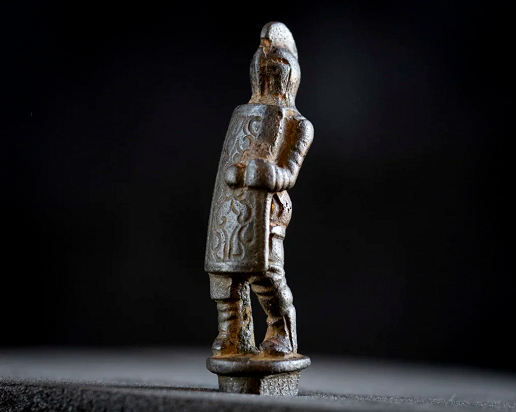
Rare gladiator-shaped knife handle gives insight into Roman celebrity culture
A remarkable discovery at Hadrian’s Wall in Northumberland, England, has shed light on the enduring celebrity status of Roman gladiators. A knife handle crafted from copper alloy, depicting a "secutor" gladiator, was found in the Tyne River near Corbridge Roman Town. According to English Heritage, the secutor, a heavily armed gladiator, was often pitted against the "retiarius," a lightly armed net-wielding opponent.The intricate design of the handle features the secutor with a helmet, a large shield, and a sword held in his left hand, suggesting he was left-handed. In ancient Rome, left-handedness was deemed unlucky, leading experts to speculate that the figurine may represent a specific gladiator.Despite their often enslaved or criminal origins, successful gladiators achieved widespread fame. "Gladiators had individual fans who would follow them and even give them gifts," said Frances McIntosh, curator for Hadrian’s Wall. The knife handle may have been commissioned by a fan of the gladiator it depicts.The knife handle was discovered in a river at Corbridge Roman Town on Hadrian’s Wall in Northumberland, England. English HeritageThe discovery underscores the pervasive influence of gladiator culture, even on the remote edges of the Roman Empire. Gladiators, celebrated for their muscular physiques and strength, were heartthrobs of their time, attracting admiration from women, including those of high status.This rare piece of memorabilia provides a fascinating glimpse into the Roman world, highlighting how the allure of gladiators has persisted through millennia, now rekindled with the anticipation of Ridley Scott’s *Gladiator II*, set for release on November 22.